Tuesday, March 29, 2011
The Resume is dead? Or has is metamorphosed into something more dynamic, writing the Self
This presentation is intriguing because the presenter does have a point, despite the fact that I am usually very weary of marketing in general. The ubiquity of online media and social networking, especially its ease of use, gives employers the ability to consider possible employees in much greater detail. However, this needs to be tempered with a greater critical eye on what one reads and takes as truth online. It is all to easy to take a surface view of an applicant especially is the main way they have communicated is via visual imagery - I guess unless you are hiring a photographer or visual media developer. This presentation does bring to the fore the dramatic change in how people are using online media ; you can now put yourself out there, carve a space or niche that is you. But this takes time and is not something that can be done over night. A blog is a good place to start, then twitter, Facebook and LinkedIn. But before you go nuts... social networking is something that requires careful consideration, planning, nurturing and crafting.
So what does this mean for teachers, teaching and knowledge in general?
Everyone can have a say. This increases the plurality of opinion both informed and ill-informed. Teachers can share and compare classroom practice hopefully resulting in improved approaches to teaching and learning. All this may sound trite for those of you already blogging but so many teachers are still cautious of taking the first step of creating that online space populated with who they are as teachers. This space/niche over time becomes a representation of who you are, textually constructed with meaning emerging over time, your thought become language and your language is thought
What can you do or not do?
Just write, but make use of the draft function. Do not write then publish straight away. Writing is a reflexive practice,
"The language one uses is designated by one's relational position in a field or social space. Different uses of language tend to reiterate the respective positions of each participant. Linguistic interactions are manifestations of the participants' respective positions in social space and categories of understanding, and thus tend to reproduce the objective structures of the social field." source
Of course the other thing to remember is the Web is open so post with care.
My recent professional development session relating to this topic
Recently I presented a professional development session to a few of my colleagues about using social networking tools to create and expand personal learning networks (PLN). The online space/niche which form your online professional persona is feed and nourished by these PLNs. So your PLN and your online presence become a dynamic presentation of YOU, this becomes your resume in a continual state of becoming, a living textual,visual and signed manifestation of yourself. Although Eric Fromm's "To Have or to Be" predates the internet and the social web the following excerpt
[Man's] human relations to the world- seeing, hearing, smelling, tasting, touching, thinking, observing, feeling, desiring, acting, loving- in short all the organs of his individuality ... are in their objective action [their actions in relation to the object] the appropriation of this object, the appropriation of human reality. This is the form of appropriation in the mode of being, not the mode of having...
provides a sketch of the idea that your online persona within your space/niche when seen through the prism of the idea of a resume is you looking back at yourself - digital reflexivity perhaps.
Share


Sunday, March 20, 2011
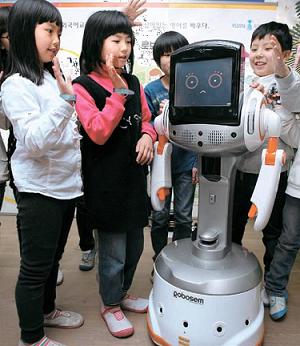
Android, is it robotic pedagogy or is the pedagogy robotic?
Is this the future face of teaching?
« The irrationality of a thing is no argument against its existence, rather a condition of it. »
Nietzsche
Perhaps this is a fully physical realization of Drill and Practice. No matter how good the simulation is teaching remains a human practice. Education is for humans by humans as it is at its core a human and social practice. The idea of robotic teachers is the ultimate end game of what is increasingly an irrelevant modernist view of education. Robotics is a tool. Learning how to build, interface and engage with these tools are important but this is a large step away from cybernetic anthropomorphism
 It seems to be a rather consistent obsession of Korean and Japanese robotic engineers that a teacher can be simulated by a robot. Recently I heard professor Hiroshi Ishiguro on the ABC program Night Air, 13 March discuss these ideas and use the term post-human. I'm not a protein based chauvinist anti silicon and hater of robots but... To envision a world that is post human is to have a vision where our 'being' is no longer present. It is all to easy to forget the beauty that humans can create and experience, a beauty that is human not post-human. The rare thing that is birth, life and death and the fact that we are conscious of these processes is part of 'being-in-the-world'
“Dasein exists. Furthermore, Dasein is an entity which in each case I myself am. Mineness belongs to any existent Dasein, and belongs to it as the condition which makes authenticity and inauthenticity possible.” Heidegger
http://bit.ly/gUMpLr
Share
« The irrationality of a thing is no argument against its existence, rather a condition of it. »
Nietzsche
Perhaps this is a fully physical realization of Drill and Practice. No matter how good the simulation is teaching remains a human practice. Education is for humans by humans as it is at its core a human and social practice. The idea of robotic teachers is the ultimate end game of what is increasingly an irrelevant modernist view of education. Robotics is a tool. Learning how to build, interface and engage with these tools are important but this is a large step away from cybernetic anthropomorphism
“Dasein exists. Furthermore, Dasein is an entity which in each case I myself am. Mineness belongs to any existent Dasein, and belongs to it as the condition which makes authenticity and inauthenticity possible.” Heidegger
http://bit.ly/gUMpLr
Share
Friday, March 4, 2011
Data, Information, Manipulation, Fear...
What is said on the Internet is not secret, which some teachers have found out the hard way. With freedom comes responsibility but also the responsibility lies with those that hold and hopefully protect private data and information,
"Information privacy, or data privacy is the relationship between collection and dissemination of data, technology, the public expectation of privacy, and the legal and political issues surrounding them" (source: http://en.wikipedia.org/wiki/Information_privacy).
But when do the lines get blurred, when does information become a tool of power? At the point that power controls information then the production of knowledge is compromised and wisdom becomes dogma. Orwell then is a futurist, double think destroys rationality, newspeak becomes the lingua franca and room 101 becomes the destination for the erudite and the free.
dou•ble•think ('d&-b&l-"thi[ng]k), noun, Date: 1949 : a simultaneous belief in two contradictory ideas.

Share
Wednesday, March 2, 2011
X Marks the Spot (Generation X teachers), but are we Fitter Happier more productive
I am going to go right out a limb here with a broad brush and splash a bit of text around ...[insert legal babel that I mean no harm] Being a Generation X teacher means for me that I have a highly critical view of any form of media, especially commercially based media and possibly the whole modernist ideal of unfettered continual economic growth, essentially my views could broadly seen as postmodern [1]. Unlike my more mature colleagues who fought for or against the reds under the bed only to watch it all implode,
 As the Iron Curtain cracked the fall of the wall looked inevitable. In the evening of November 9th, 1989 Gunter Schabowski, Minister of Propoganda, read out a note at a press conference announcing that the border would be opened for "private trips abroad” (http://www.berlin-life.com/berlin/wall)
It was cool to be a leftist and Che Guevara was on t-shirts but I think only a few would have wadded their way through Das-Capital in earnest. Generation X , in Australia at least, watched the recession we had to have unfold upon our parents. Things where rather bleak on the employment front and being at school during the final phase of your high school education was not very encouraging. Those who could got jobs or went to University some just bounced from job to job [2]
 It was not really until my early twenties that the internet started to become something to watch, essentially late 80's early 90's saw the explosion of the online world. Essentially generation X was at a very important juncture in history we saw the Net grow exponentially but at the same time remembered pre-Internet mass media, Television, Radio and Print. Now we have young families and watch our children engage with the multitude of media spaces that exist. However, times are different our children and generation Y have the opportunity to be far more creative using technology that are far more powerful than those enjoyed by earlier generations. But the question is will they use this opportunity to become thoughtful creators of content and will we as Generation X teachers help them develop the critical skills for becoming active and informed contributors on the Net. Furthermore, can we teach these skills within existing educational and institutional paradigms? And one final question, as Gen X are we, Fitter Happier More Productive?
Share
It was cool to be a leftist and Che Guevara was on t-shirts but I think only a few would have wadded their way through Das-Capital in earnest. Generation X , in Australia at least, watched the recession we had to have unfold upon our parents. Things where rather bleak on the employment front and being at school during the final phase of your high school education was not very encouraging. Those who could got jobs or went to University some just bounced from job to job [2]

Share
Tuesday, February 22, 2011
Learning within the eCloud, the tipping point
 Learning occurs not only in schools but every where at every time. The human mind is wired for learning it is a fundamental reason why we as a species have covered the earth for better or worse. Now for the first time in history the sum of human knowledge and a chronicle of our times is being poured into the Internet and converted into digital forms. This is not new news and has been occurring for sometime; however, I believe we are at a tipping point. This point is defined by how people consume, create and communicate information and form knowledge and in addition how they act when informed by this information and knowledge.
With the emergence of meta tagging, for example Diggo and Delicious, the reflexive process has started in earnest. Users both informed and ill-informed are giving thumbs up to things they like, for example youTube, leaving comments on Blog posts as well as news items. The Internet has become one of the largest, if not the largest discursive spaces ever available. Anyone who doubts this only needs to wonder why various authoritarian governments spend vast amounts of resources filtering, blocking, monitoring and in some cases attempting to shut down access and user created Internet content. However, with the emergence of social networking the net is now viral and rabid and a lot harder for these governments to control.
 The Internet and social networking is beginning to display its power to disrupt and push change when faced with institutional structures and power. This in conjunction with how people consume, create, communicate information and form knowledge via the Internet and social networking has created an environment that is reactive, reflexive and in a constant state of change. The real impacts, modifies the representations of the real within the Internet. In turn the simulation of the real is connected via global networks to the creators, transmitter and receivers of data and information. This constant to and fro increases until the hyper real emerges. But this hyper real does not need to be a dystopia it can be viewed as a hybrid, a cloud of data and information that coalesces into a discursive and semiotic space. The eCloud (educational Cloud) is one region of this space. The eCloud is fed and nourished by individuals and groups who follow their passion to know, understand and share information, to make new and update/modify existing knowledge and collectively push the boundaries of the cloud; and ultimately further human wisdom and understanding.
 Share
Tuesday, November 9, 2010
Down time and space to think
The continued avalanche of data and information has created a form of confusion, more is not necessarily better. While there is lots of concern about obesity due to over consumption and our increasingly sedentary life style of equal importance is what we consume with our minds. The proliferation of media channels does not necessarily result in greater well considered discussion. However; the global reach of technologies like the internet has greatly benefited thinkers, enabling them to reach a global audience for little cost. Perhaps we are entering an ages where good ideas grow within the very media channels that produce the mindless drivel that is in danger of swamping intelligent online conversation... Perhaps
,but it remains to be seen.
This is the book that was the origin on this blog post, I have read it and it is worth while mainly because it gives a fresh perspective on ICT usage.
Share
Monday, November 1, 2010
Beginings and paradigm shifts, seeking a quite space
This is the YouTube clip that started it all for me. During this year my (twin) sons were born and children of my sons generation are mentioned in this clip. Now I am approaching my 40's rapidly and have charged into many things web2.0...ish it is time to pause. Yes the net is cool, yes social networking is cool, but clarity is the new horizon to aim for. Finding a quite space within the noise of data & information so one can touch wisdom is now so important. Having face to face time is now more important than ever because it is becoming a rare commodity. In music sometimes you hear the term "Less is More", and also quality not quantity is apt as well, perhaps this should be a mantra for us all to consider.
ICT, don't forget the 'C'
All to often we get excited about the 'I' and the 'T' when talking about ICT in education. This is understandable as it is easier to grasp a concept if it is embodied in an actual solid object, a laptop, iPhone or a digital camera. However,we are textual beings. We are surrounded text, texts in various forms which we absorb by osmosis and eventually we have a head full of semiotic static. Is it time to step back, pause, think then act?
Subscribe to:
Posts (Atom)