"You couldn't get functioning democracy without free information." I really like the experiment he did with the take a screen shot and see the difference between each others searches. This would be an excellent activity for students to do for an assignment. You could define a search term then get each student to search and screen shot on their own PC and another PC in the house. The next day print off and gather all the images place them on the floor and work out what you can tell from the search results that were returned. This activity could be a spring board for discussion topics such as, ethical use of user information, surveillance, privacy and the rights and responsibilities of individuals and corporations. So there you go, online video leads to lesson idea, leads to increased awareness by students and real connected teaching based on data gathered by students... hmmm might rethink my senior IT unit on social and ethical issues and the Internet.
Showing posts with label technology and teaching. Show all posts
Showing posts with label technology and teaching. Show all posts
Saturday, August 20, 2011


Tuesday, April 12, 2011
The next evolution of learning will occur outside of schools, Changing Education Paradigms,
Is it the institution of education that constrains learning? Schools are primarily places of socialization and the indoctrination of people to fit within the dominant economic ideology of the nation or state in which they are situated. School is not primarily a emancipatory place of learning, learning happens in school despite the school itself. The long held legitimacy of schools and schooling is now challenged by the multiple sources of information now available via information communication technologies. More recently the participatory nature of the Internet has created vast opportunities for anyone to create, modify and explore knowledge. Yes a lot of content on the Internet is mindless filler. However, this is no different from television or popular print and visual media. Therefore, the idea that the internet only provides second class information quality should be tempered with the growing realization of the codification of the body of human knowledge into digitally transmittable formats
The next evolution of learning will occur outside of schools. This change has already started the precursors being the uploading of educational content by leading American universities. Educators themselves are creating networks of like minded teachers via social networking platforms. The use of YouTube and other online video services are becoming ubiquitous. The use of online presentation sites like slide share to upload existing PowerPoint presentations and develop and disseminate new presentations. Despite these trends schools still block and restrict access to many Internet sites, especially social networks and video feeds. This attitude of blocking the perceived risky online services is based on a miss-understanding of the relative merits of the technology. Blocking this technology to protect students is often counter productive because many of them have access to social networking site from home or via a Internet enabled mobile phone.
The reason that the new state of education will occur outside of secondary educational institutions are because of the very institutional nature of schools themselves. In Australia the essentially two tracked education system private/public is equally unready or unwilling to embrace the changes that ICTs ultimately bring to learning. Public schools will strain under the lack of flexibility and work force that is heavily unionized and sometimes combative in nature, large changes can only occur via a large show of good will by all parties and this is often something that is in short supply. Private education is more flexible but is still bound by the expectations of the parents, whom provide private capital, and the culture of the school which may be etched into the collective psyche of the staff and be bound to a reproduction of class based structures and captive to narratives of perceived success.
The great hope for education lies in the increased professionalization of it's workers. Teaching at one time was a career that was mainly dominated by women, and therefore often underpaid and not held in high regard as other professions due to unenlightened patriarchal social structures. However, the sisterhood lead the charge and pushed for change to such an extent that now the career driven look back over their shoulders and see the ghost of motherhood haunting their success. Teaching is now better paid and held in higher -although more recently this is an arguable point- regard but just as these victories enabled the battle weary to pause for breath the ICT revolution arrived. However; the leaders in education do realize the profound impact of the information technology revolution. While some leaders may not understand or have a deep technical grasp of the direct impact of ICTs, good leaders have given the space necessary for educational ICT innovators to ply their trade and experiment.
Share
Sunday, March 20, 2011
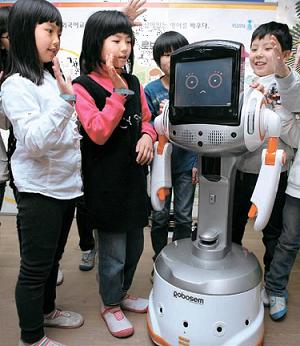
Android, is it robotic pedagogy or is the pedagogy robotic?
Is this the future face of teaching?
« The irrationality of a thing is no argument against its existence, rather a condition of it. »
Nietzsche
Perhaps this is a fully physical realization of Drill and Practice. No matter how good the simulation is teaching remains a human practice. Education is for humans by humans as it is at its core a human and social practice. The idea of robotic teachers is the ultimate end game of what is increasingly an irrelevant modernist view of education. Robotics is a tool. Learning how to build, interface and engage with these tools are important but this is a large step away from cybernetic anthropomorphism
 It seems to be a rather consistent obsession of Korean and Japanese robotic engineers that a teacher can be simulated by a robot. Recently I heard professor Hiroshi Ishiguro on the ABC program Night Air, 13 March discuss these ideas and use the term post-human. I'm not a protein based chauvinist anti silicon and hater of robots but... To envision a world that is post human is to have a vision where our 'being' is no longer present. It is all to easy to forget the beauty that humans can create and experience, a beauty that is human not post-human. The rare thing that is birth, life and death and the fact that we are conscious of these processes is part of 'being-in-the-world'
“Dasein exists. Furthermore, Dasein is an entity which in each case I myself am. Mineness belongs to any existent Dasein, and belongs to it as the condition which makes authenticity and inauthenticity possible.” Heidegger
http://bit.ly/gUMpLr
Share
« The irrationality of a thing is no argument against its existence, rather a condition of it. »
Nietzsche
Perhaps this is a fully physical realization of Drill and Practice. No matter how good the simulation is teaching remains a human practice. Education is for humans by humans as it is at its core a human and social practice. The idea of robotic teachers is the ultimate end game of what is increasingly an irrelevant modernist view of education. Robotics is a tool. Learning how to build, interface and engage with these tools are important but this is a large step away from cybernetic anthropomorphism
“Dasein exists. Furthermore, Dasein is an entity which in each case I myself am. Mineness belongs to any existent Dasein, and belongs to it as the condition which makes authenticity and inauthenticity possible.” Heidegger
http://bit.ly/gUMpLr
Share
Monday, November 1, 2010
Beginings and paradigm shifts, seeking a quite space
This is the YouTube clip that started it all for me. During this year my (twin) sons were born and children of my sons generation are mentioned in this clip. Now I am approaching my 40's rapidly and have charged into many things web2.0...ish it is time to pause. Yes the net is cool, yes social networking is cool, but clarity is the new horizon to aim for. Finding a quite space within the noise of data & information so one can touch wisdom is now so important. Having face to face time is now more important than ever because it is becoming a rare commodity. In music sometimes you hear the term "Less is More", and also quality not quantity is apt as well, perhaps this should be a mantra for us all to consider.
Sunday, October 10, 2010
SharePoint 2010 as an effective Learning Gateway
An interesting presentation about sharepoint in a secondary school context
Tuesday, June 29, 2010
Sir Ken Robinson: Bring on the learning revolution!
This is a very stirring speech and it is hard to disagree with him. If we live in the knowledge age then investment in education needs to take highest priority. Not only should education be high priority but the standing of teachers and educators must also be elevated in the eyes of the wider public. All to often we raise persons of fame and fortune to the lofty heights of public adulation only to find the feet of giants are made of clay. Another common view, touted in the IT industry is, "well he got in to College then dropped out and became a billionaire!". Why this maybe true for some very successful IT entrepreneurs it really only tells part of the story. Often forgotten are those who do work hard at University despite great financial and personal challenges and contribute to enriching the culture of a nation. Furthermore, in your local community or city thousands of doctors, engineers, nurses, teachers and countless other professionals create the delicate network of interactions that create the very societies we live in. However, I digress and Sir Ken is right that we need to think differently about education. If we can maintain the creativity and imagination that a young child has and enfold it with a disciplined academic mind that is tolerant of other cultural perspectives and has a well developed ethical compass great things will happen. Now the challenge for education is to create, foster and champion systems, that encourage, grow and empower their citizens to continue to be creative and constructive thinkers, life long learners and also positive nurturing human beings. If we do this not one or a handful of people will be remembered as the paragon of virtue and financial success, but an entire generation will be remembered as the driving force behind a learning revolution. A revolution that we need and have to have.
Tuesday, June 22, 2010

Sunday, March 7, 2010
Reading and teaching IT, don't forget the reading
It is all to easy to get entranced with technology and forget that unless you can read a lot of the power of technology is not available. The amount of text that the Internet consists of is large and yes there are heaps of movies, images and other interactive items on the net. But the ability to engage with text is paramount in order to participate meaningfully in a learning environment. This clip points out, and rightly so, that a wide range of knowledge can help and support reading. Therefore, those who do not advocate a broad based education at primary and secondary level are really closing off large amounts of human knowledge. A narrow education reduces a students exposure to the richness of human knowledge and understanding.
Sunday, February 28, 2010
Why I just love the Internet, seek and ye shall find... mostly
I was reflecting upon how the Internet has help me with my teaching over the past 6 years. We certainly have witness a massive change over the past six years and my job would be a lot harder without it. The number of resources for my subject are huge and most of the time it takes very little time to track down a book or article that can address my interest, or my students questions. But here is the problem, to much stuff and not enough time. In order to help students get the best out of the resources on the Internet students MUST learn how to be critical. When looking at any information from the net the first thing I tell them to think about is "Does this serve a commercial interest?". Also looking and the web address is a good indicator to, "Look at the URL... what does this tell us?".
The currency of the information is also a major factor, the net has been around for a while now and there is a lot of information which was posted over 10 years ago. You don't have to be a rocket scientist to know that 10 years calendar time is a lot longer when you are thinking about currency of information on the net. Now this all may sound like old hat to teachers but just sit back for a while and watch your students use the net to find information. Many of you will be shocked at how even know after the net has been in our classrooms for sometime students still don't know how to move beyond the first few matches in google.
The currency of the information is also a major factor, the net has been around for a while now and there is a lot of information which was posted over 10 years ago. You don't have to be a rocket scientist to know that 10 years calendar time is a lot longer when you are thinking about currency of information on the net. Now this all may sound like old hat to teachers but just sit back for a while and watch your students use the net to find information. Many of you will be shocked at how even know after the net has been in our classrooms for sometime students still don't know how to move beyond the first few matches in google.
Tuesday, February 23, 2010
Getting teachers to use Moodle
Currently I administer a Moodle for a secondary school and I am also currently developing a second for our other campus. One question that always comes my way is how do you get the recalcitrant to use Moodle. The answer is I don't, the students do. After awhile most teachers get on board, it is a slow process but slowly is the best way to go. Usually I focus my attention on the keen but technically challenged teachers and encourage them to have a go, this is always supported by one on one help. Over the past four years and three implementations this appears to be the best way to go, find an interested teacher and give them one on one help and hopefully others will follow. It is impossible for one person to adequately train a large number of teachers of various capabilities and motivation but get a few key people on the band wagon and this is a good start. What is cool is that students do actually appreciate Moodle even though many will not admit it in front of their peers.
Saturday, January 2, 2010
Rise of information and communication technology (ICT) in schools
“…rise of information and communication technology (ICT) in schools is unstoppable, and developments in ICT encapsulate broader trends in education. ICT touches every aspect of education, building in new networks of teachers and driving new paradigms of teaching and learning, and putting teachers and students in contact with each other on a truly global scale.” (Cohen, Manion & Morrison, 2004, p.59)
I wonder how some schools would operate if they lost, email, Internet and network access for a week? I would say it would not be pretty. Therefore, it could almost be said that a Secondary schools core business, teaching and learning, are severely hampered without properly implemented or managed IT.
I wonder how some schools would operate if they lost, email, Internet and network access for a week? I would say it would not be pretty. Therefore, it could almost be said that a Secondary schools core business, teaching and learning, are severely hampered without properly implemented or managed IT.
Tuesday, July 21, 2009
Creating a Moodle Quiz
A great tutorial on how to set up a Quiz in Moodle, quizzes are really good for checking understanding, revision of key concepts and giving immediate feedback to students. You are all most probably saying but when will I find the time to write these. I suggest get each teacher in your faculty to log into the course and write a couple of questions each then construct the quiz from these. Even better break your students up into groups, group one for questions, and group two for answers. Get the students to write the quizzes and answers and upload them as a txt file so you can copy and paste them with little trouble over to the question bank.
Monday, July 20, 2009
week one of laptop roll out
We rolled out around 70 laptops at our school last week and Monday was the first day for students and teachers to use them in class, seems to be running well so far.
Wednesday, July 15, 2009
Web 2.0 and learning
A good presentation from BECTA in the UK, I really like how all the students are learning together and using IT as a tool to create and reflect on their learning. An interesting point is made that space must be made to give credit for this type of learning. What is needed is at the teacher training stage to demonstrate to teachers what can be done to enrich and engage students in their subject areas using ICT.
Saturday, July 4, 2009
theirFuture
I created this presentation for teachers at my school as a way of starting discussions about how we as teachers can use “The Network/Internet” as a learning space. What I find particularly exciting about the continually growing Internet is its ability to create opportunities for creating and sharing stuff . What this stuff is is up to us and as teachers it is incumbent upon us to guide students to create and participate constructively in the online environment.
Monday, June 29, 2009
Subscribe to:
Posts (Atom)